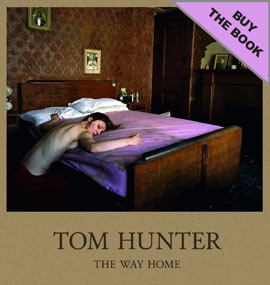


Tom Hunter’s photographs are featured with Nathalie Olah essay in World of Interiors Magazine for the ‘Earthly Paradise: Radial Living in the UK’, exhibition at the William Morris Gallery, London
SQUATTERS’ RITES
Imagine a time before young people were stultified by social media and exorbitant buy-to-let rents. Photographer Tom Hunter doesn’t have to: he was there, living – and documenting – the dream as part of east London’s freewheeling, close-knit squatting community in the 1980s and 90s. So what became of his peers and that subversive spirit? As a new exhibition on such ‘earthly paradises’ commences, Nathalie Olah looks wistfully at Hunter’s poignant large-format pictures taken in those prelapsarian years

‘And the Lord God took the man, and put him into the garden of Eden to dress it and keep it’ – Genesis 2:15. The Earth, it seems, was not complete until Adam and Eve had left their mark on it. According to the Old Testament, decorating the garden of Eden was the duty of the first people on earth, almost as if the Christian faith considered man and God to be artistic collaborators. Albrecht Dürer depicted the pair adorning tree branches with little plaques, fixed in place with wire hoops. ‘Dressing’ the garden was an idea that John Milton took one step further in Paradise Lost, his retelling of man’s fall from grace. In that epic poem he dedicates large parts to the first couple’s styling and shaping of the garden. This is both for their own delight, but also to please their guests, who arrive from different parts of the heavens.
Milton was a Puritan. He served as the Secretary of Foreign Tongues under Oliver Cromwell, who famously banned Christmas celebrations and made people wear plain, austere clothing. What does it say about modern renting culture that even a Puritan took a more progressive stance on matters of home decoration?
As of 2024, almost 40 per cent of the British public were registered as tenants, either in the private or social-housing sector. This means that around 25 million people in the UK face some kind of restriction on what they can and can’t do to their homes. Private landlords almost universally insist on the walls of their properties remaining white and unmarked for the duration of a tenancy. Failure to comply can result in deposits being withheld and even legal action. As a result, most of us won’t know the joy of decorating our homes until we buy one, if we ever do.
In my last book, Bad Taste, I wrote about how the rental market had flattened our imaginations, as well as the trends it had produced – dark grey paint, a kind of status symbol, distinguishing home owners from those forced to live in bland white buy-to-lets. I’m not the only person who’s written about this. In her 2024 novel The Lodgers, Holly Pester describes an uncanny world, so sterile that almost nothing can stick to it: not relationships, jobs or even bodies. What Pester captures is a kind of profanity: an architecture of alienation, where two flatmates will hardly know each other, because they’ve hardly been given the chance to know themselves.
Perhaps this is the point of the sterile rental flat. If it were more conducive to love and self-esteem, the inhabitants might start to resist it. On the other hand, I think that if I were to describe my own idiosyncratic faith as a kind of religion, then Tom Hunter’s photographs would serve as holy relics on my altar. In the 1980s and 90s, Hunter used his large-format camera to document Hackney’s squats. The resulting body of work is jewel-coloured and as bright as stained glass. I’ve stared at the images for many hours, lips apart. I imagine I look a lot like churchgoers who once stared at Renaissance paintings of Adam and Eve. What these photos contain is no less idyllic and beyond reach to us now. Occasionally, I console myself that the squatters are crusties and asset-rich trust-fund kids, having a good time before they receive their inheritances. Even if true, it doesn’t change the fact that what I’m looking at is still wildly better than our present reality.
One picture is of a young man, lying back on a bench, in a room with yellow and plum walls. The ceiling is painted in a chequerboard pattern of the same colours. A paper decoration in the shape of a flower hangs from the window. Next to that is a flimsy print of the Moulin Rouge, and on the adjacent wall, a cut-out of Shere Khan, from Disney’s The Jungle Book. The man’s attitude and the odd assortment of objects are both inscrutable. We cannot infer from them his class, profession or even much about his personality.
What I realised is that neither he, nor the house, nor the photo is trying to signal anything at all. That’s precisely what draws me to Hunter’s work: the subjects are not thinking about how they will be perceived by others. No audience exists in their minds. How rare is it now to gaze at an image in which both the subject and their surroundings are completely unconcerned about how they might be perceived? What does it mean to live without those reflexes? How might we decorate our homes if we thought that no-one beyond our immediate friends and family might see it? If there wasn’t a financial or social imperative to impress the right people or project a certain image? If we weren’t always worried about the landlord in our heads?
Hunter’s photographs show us what life would be like without that perpetual strain and anxiety. It’s not their colour or the crowdedness that signals life necessarily, though it does, but the total indifference to an external, objectifying gaze. In another photograph, three people sit around a covered table. A woman in the foreground smiles at the viewer. Behind her sit two men, one of whom looks depressed or jilted. It appears to be staged, but for functional reasons. Perhaps they are publicising a play or an independent film. It’s Vermeer staging in a Kubrick palette, subtle symbolism in a range of over-saturated yellows, blues and reds.
The walls are marigold, the fireplace cerulean. The woman wears a cardigan the colour of poppies. A cheap Modigliani print has been stuck to an open shutter. Romance, heartbreak, love, depression, anger, euphoria – all seem to be present and possible in these images. The subjects lack the glazed, faraway expression of those who are always second-guessing themselves. Let’s not shy away from how profound a loss this is. Hunter captured something essential to the human experience, and today his photographs act as a reminder of what we should be fighting for.
Creativity? Beauty? Decoration? What all of these terms refer to is a visible trace of people who enjoy a reciprocal relationship with their surroundings, who take from it and also give back to it; who imprint themselves on it and allow themselves to be imprinted. It’s the opposite of aestheticisation, consumer desire, ‘good taste’, all of which serve to alienate us from one another. It’s why, despite all the various colours, styles and ages, Hunter’s scenes all have a harmony to them.
What was it, in the end, that characterised life after the fall? What happened when Adam and Eve were cast out of the garden they had called home, and decorated according to their own preferences? Self-consciousness. An awareness that they were naked, and an awareness that someone was judging their every move, which, from that point forward, would be shaped and styled according to shame and a desire for acceptance. This was what disturbed the beauty of that first Eden, and possibly also that second paradise, which existed for only a few short decades just north of Hackney Road.